The Devil's Flute Murders, discovering Japanese murder mysteries

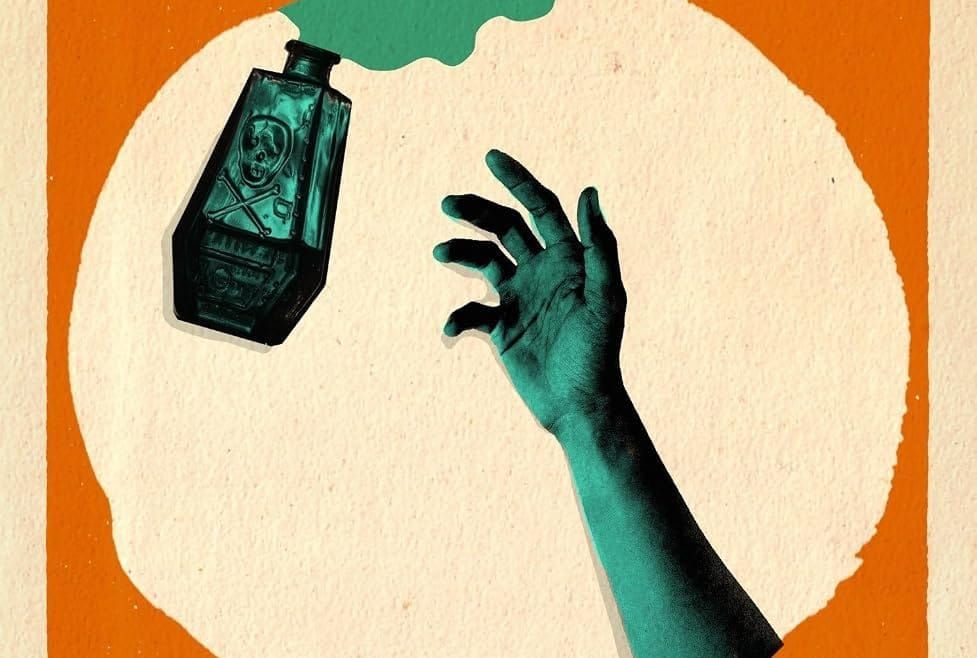
I'm always looking for new universes and authors. I bought this book purely because the cover art looked amazing (thanks to the Pushkin Vertigo English edition), and because I wanted to discover Japanese murder mystery authors. As I couldn't find any books by Edogawa Rampo at the time, I ended up looking at The Devil's Flute Murders by Seishi Yokomizo, about whom I knew nothing. But oh boy, here's further proof that some of the best reads are the most unexpected.
The Devil's Flute Murders tells the story of a once-noble family in post-war Tokyo who are still trying to cling to their wealthy and powerful past while the city lies in ruins and the people are taking power (or at least some of it) away from the old noble families. But things get worse when the old Viscount Tsubaki, the family's head, is found dead. Then another family member dies during a divination ceremony where they tried to conjure up bad spirits with the help of a shady character. This is when Kosuke Kindaichi, the hero of all the murder mysteries written by Seishi Yokomizo, comes on the scene. He's not the kind of detective you would expect. Eccentric and scruffy, he completely defies the stereotype of the brilliant master detective, but he's great at what he does. Despite his appearance, he can sense and deduce things that others cannot, especially the police detective he's working with. Being in the presence of a locked-room murder case arouses his senses like a spider's sense of danger. He clearly enjoys toying with those around the murder, setting them up in their own lies to find out the truth, and this is what makes the book such a lovely read. There is a certain burlesque to it: the nobles are much more foolish than they realise, clinging to a status that no longer means anything, and they can barely grasp why anyone would try to harm them.
As such, it offers an interesting insight into post-war Japan. The country is in ruins, society is undergoing major changes in its relationship with nobility, and the streets are no longer as safe as they used to be. While some people are clinging to their wealthy past, others are trying to survive, and a murder in a noble family fails to sadden anyone around them. The family comes across as idiotic, which is an effective way of setting up the later revelations about what really happened. As I can see from this novel, the author loves to defy expectations, which is what makes the book a successful murder mystery. Not only because of the investigation itself or the revelations about the murders, but also because the author understands how to create the right atmosphere and exploit the post-war setting.
It has its issues, such as the author's failure to properly justify some deductions, which makes it seem as though his star detective gets ideas out of nowhere. However, these rare occurrences do not distract from the enjoyment of a well-rounded story with memorable characters, all of whom seem to have something to hide, thanks to excellent characterisation and some very well-written dialogue. Despite some very long descriptions and chapters where the story feels a bit too narrated, the English translation does a great job of keeping the pace and interest alive. This is probably due to Seishi Yokomizo's style of telling the story as if an acquaintance of his had explained it to him. This can make things overly complicated when they are not actually complicated, but I suppose it can also be explained by the fact that it is a Japanese book written in 1947 with its own style and era. On the other hand, there's something very modern about the investigation, which makes it an easy and fun read. It has definitely made me want to read more from this author. I did just that, going straight to The Honjin Murders, the first story in which Kosuke Kindaichi appears. I found it a tad underwhelming as the investigation wasn't particularly well executed, but it was fun nonetheless thanks to its atypical detective and setting. I recently bought The Inugami Curse and will surely read it soon enough. But in the meantime, I finally found some Edogawa Rampo books and cannot wait to get into it.